
Walk into any window & door dealer in America and ask the owner what software they use. Watch them count on their fingers. Then watch them run out.
Most window & door dealer-owners we talk to are paying $4,000 to $15,000 a month for software. Not on one platform. On 8 to 14.
CRM. ERP. Marketing automation. Quoting. Manufacturing order entry. Install scheduling. The mobile app for crews. Accounting. Permits. Reviews. The receptionist service. The texting tool. The Google Sheet that tries to glue it all together.
The CRM doesn't know what got built. The factory doesn't know what got sold. The accountant doesn't know what got installed.
Someone whose actual job title is "ops," spends half their week being the integration layer between systems that should have been one system.
This is what running a window & door dealership looks like in 2026.
And it doesn't have to be.
The pain isn't a missing feature. It's a broken model.
Window & Door is a multi-billion-dollar industry inside one of the largest sectors in the U.S. economy. It is also one of the worst-served by software.
Every category of tool you'd expect to exist does. CRM. ERP. Marketing automation. Quoting. Scheduling. Accounting. Most have a window-and-door-specific version. None of them work together. All of them charge per seat. Most were architected before the iPhone existed.
The result is the stack. Eight to fourteen tools per dealer. Paid for separately. Glued together by a person. Leaking information at every seam.
Every dealer-owner we've talked to feels this. The complaint is universal:
- The CSR team missed 21 calls this week during non-business hours (...and 8 during business hours).
- Digital leads sitting in someone's inbox for days.
- Quotes take from 45 minutes to 2 days to present to the homeowner for a single option set.
- The factory doesn't know what was promised at the kitchen table.
- The CRM doesn't know what the factory built.
- The install crew doesn't know what changed at the kitchen table or during critical measure.
- The accountant doesn't know what was actually installed until somebody emails an updated spreadsheet.
This is not a feature problem. There is no missing column in the CRM that will fix it.
This is a model problem. The model is wrong.
The assumption underneath every one of these tools is that you would hire a person to do the integration work, the data entry, the follow-up, the reconciliation. That person is increasingly hard to hire, increasingly expensive when you do, and increasingly unnecessary.
The work they were doing is exactly the kind of work AI is now good at.
How we got here.
Most home-improvement software was designed for a world that no longer exists. A world where the alternative was a pen and paper. Where integrations were a two-line bullet on the sales sheet and a six-month consulting engagement in reality to get it right. Where AI was a feature you'd consider adding next quarter rather than the substrate the product was built on.
Walk into any window & door dealership today and the tools tell on themselves:
- The vertical CRMs were built in 2008 and have been maintained since. The interfaces still feel like 2008.
- The dealer ERPs were built in the '90s and refactored once. They were architected for a desktop in an office, not a phone in a truck.
- The marketing tools live in a different cloud than the ops tools, which live in a different cloud than the manufacturing tools. None of them know what the others did.
- "AI" is bolted on top. A chatbot dropped onto a 12-year-old data model. It can summarize an email. It cannot finish a job.
- Integration is sold as a separate product line.
Owners feel it. The software is clunky. Crews don't want to open it. Office staff workaround it. Onboarding a new hire takes weeks and you still find them keeping a paper log "just in case." Every vendor's "deep integration" stops at the seam where their product ends and the next one begins.
And the cost of this mess keeps rising - chipping away at your bottom line without giving you line-of-sight to how to actually improve profitability.
This isn't bad software. It was correct for its era. The era ended.
These are the dinosaurs still walking around because their customers haven't yet figured out there is something else to walk to.
WindowEdge AI is the Agentic Business OS for Window & Door.
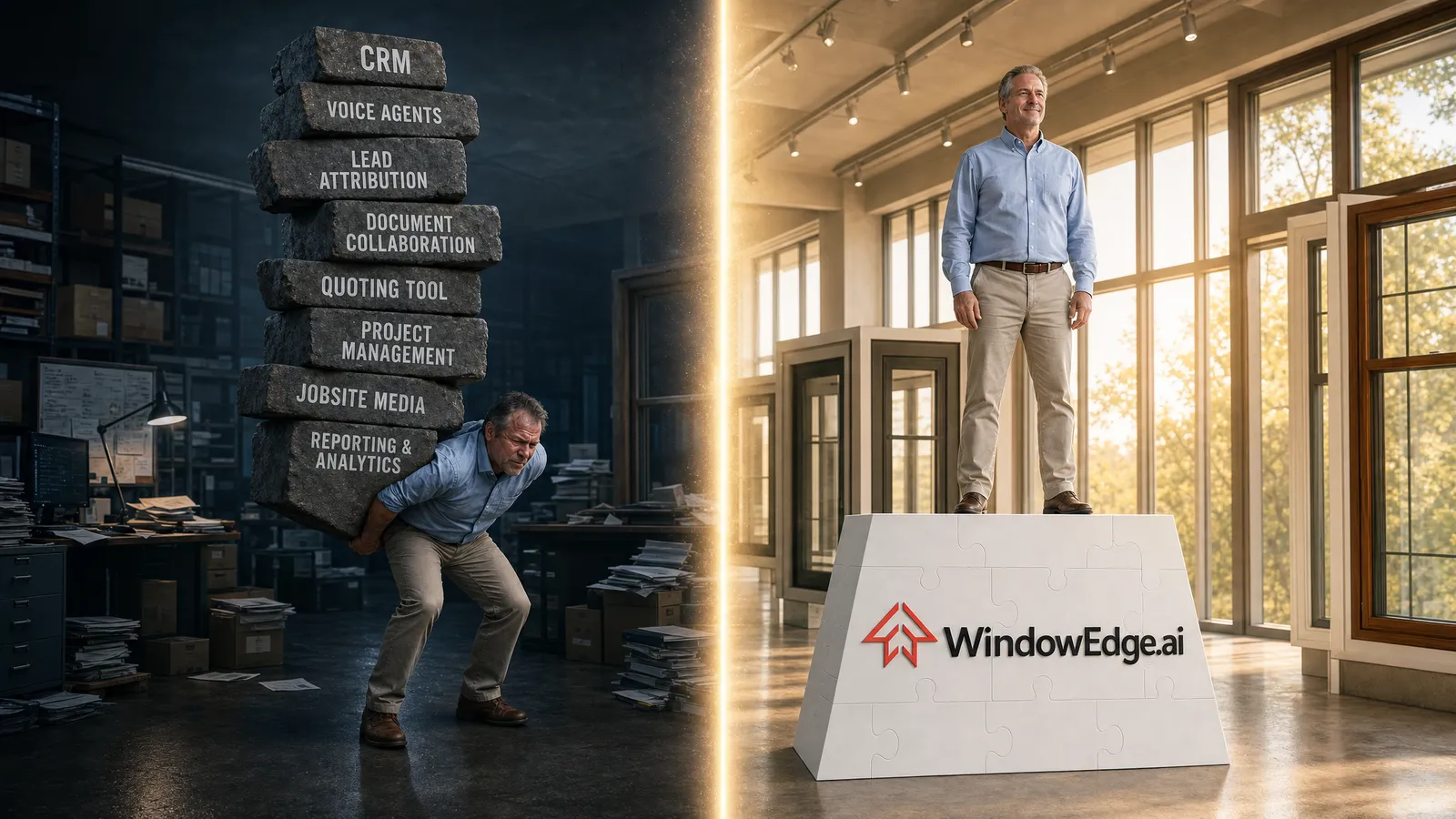
WindowEdge AI is not a CRM.
It is not an AI receptionist.
It is not a project management tool, a scheduling tool, a manufacturing platform, or a marketing system.
It is not the thirteenth tool in your stack.
It is the replacement for your stack.
We are building the Agentic Business OS for window & door dealerships. One system that runs your shop end-to-end, with a team of AI agents doing the work the next office hire would have done:
- The CSR/receptionist agent that knows every customer, every appointment and every job instantly.
- Quoting agents that build accurate multi-manufacturer & multi-configuration quotes in seconds
- The survey & rehash agents that improve close rates and deliver actionable insights every day
- Project agents that pull the project forward every second of every day without intervention.
- The scheduling agent that pulls from the signed contract, the manufacturing ETA, and the crew calendar without anybody asking.
- The follow-up agent that fires the review request after the install is photographed and confirmed, personalized to the install.
- The marketing agent that knows what closed and why, because it lives in the same system that closed it.
One platform. One source of truth. A team of agents on top.
Priced not per seat (because the seats are doing less and less of the work) but per business, scaled to what the platform produces.
Every part of the system was built around how a real window & door dealership operates. The data model knows what a re-measure is. The quoting agent understands frame types and glass packages. The install agent knows that a custom door order can take six weeks and a stock window order can ship next day. This is not a horizontal CRM with a window-and-door wrapper. This is a window-and-door-native platform.
The Agentic Business OS is here: it is a new category and a new era, and it starts today.
Schedule a demo of the first Agentic Business OS for the Window & Door industry →
